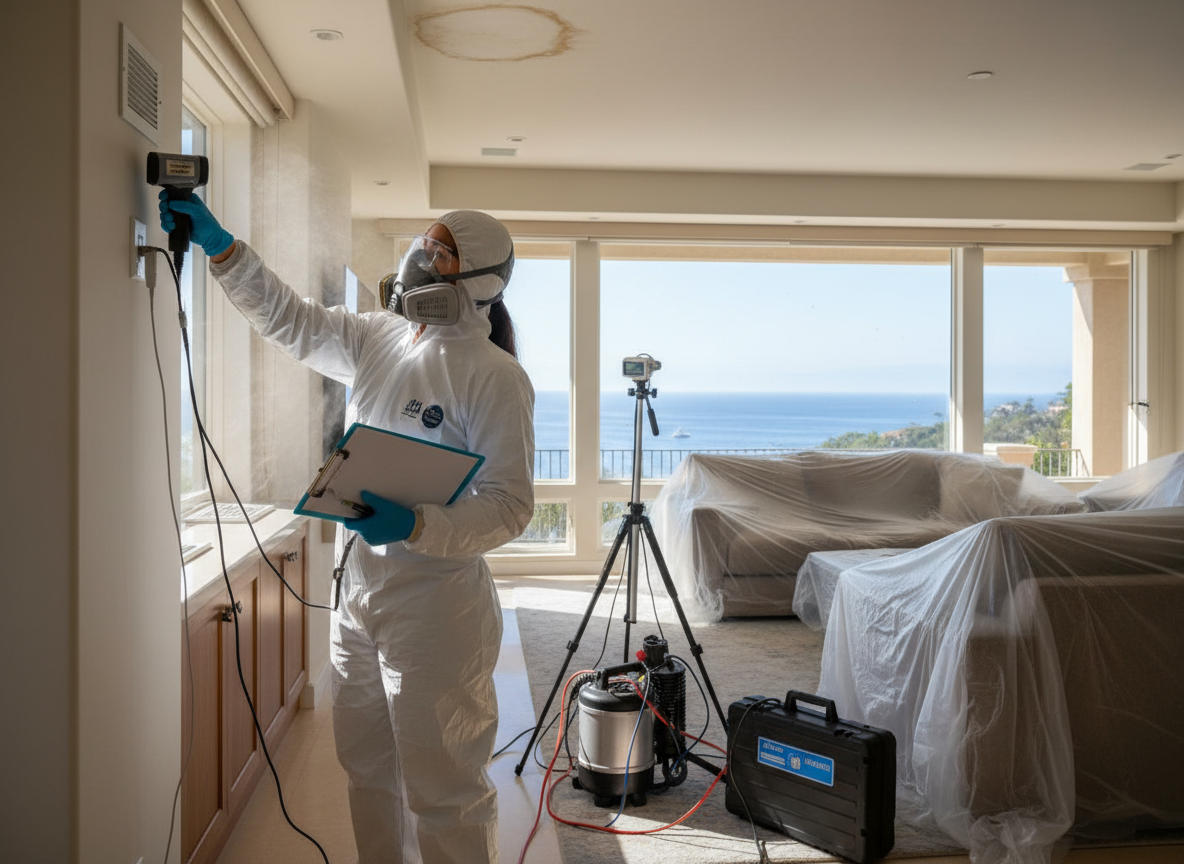
Corona Del Mar homes built before the 1980s in neighborhoods like Corona del Mar Village often feature older plaster and lath construction that traps moisture during the cool, wet winters typical of Orange County's Mediterranean climate. Air quality and mold testing here requires checking behind baseboards, in attic spaces above Sherman Library and Gardens, and along bluff-facing walls where fog from Corona del Mar State Beach can seep indoors. Technicians sample both air and surface materials because summer dry spells can mask hidden growth that reactivates when winter rains return.
Testing protocols must also consider proximity to Newport Beach and Laguna Beach, where salt air accelerates corrosion on HVAC components and creates micro-condensation points inside ductwork. In Corona Highlands and Irvine Terrace, hillside grading sometimes directs runoff toward foundations, so inspectors pay special attention to crawl spaces and slab edges after storms. Samples are sent to independent labs for species identification, helping differentiate between common outdoor molds and those indicating an indoor moisture source that needs remediation.
Homeowners along the Corona del Mar Bluff Path frequently discover that recent window replacements or roof work have altered airflow patterns, concentrating spores in previously unaffected rooms. A full test includes multiple indoor and outdoor air samples plus moisture metering of drywall and framing. Results guide whether remediation is required or if improved ventilation alone will resolve elevated spore counts common after winter rains.
Technician insight
In Corona Del Mar, the thing that catches most people out with air quality and mold testing is how our cool wet winters push moisture into the older plaster walls of homes in Corona del Mar Village and along the bluff. Homeowners often test only the obvious bathroom and miss the condensation that forms behind kitchen cabinets facing the ocean.
Hidden Growth After Window Replacement
A homeowner in Irvine Terrace noticed musty smells after replacing ocean-facing windows. Testing revealed elevated aspergillus behind the new frames where sealant had failed against winter rain. We isolated the affected section, confirmed the source with moisture readings, and provided a targeted remediation plan that prevented spread into adjacent rooms.
How it works
- 1
Site Walkthrough
Technician inspects all accessible areas of the property, noting construction type, recent water events, and ventilation paths common in Corona Del Mar homes.
- 2
Sample Collection
Air cassettes, tape lifts, and moisture readings are taken from multiple rooms plus an outdoor control sample near Corona del Mar State Beach.
- 3
Laboratory Analysis
Samples are processed by a third-party lab to identify mold genera and quantify spore levels relative to outdoor baselines.
- 4
Detailed Report
Findings are delivered with photos, lab results, and recommendations tailored to local building practices and seasonal moisture patterns.
Pricing
Pricing varies by square footage, number of samples required, and whether crawl space or attic access is needed.