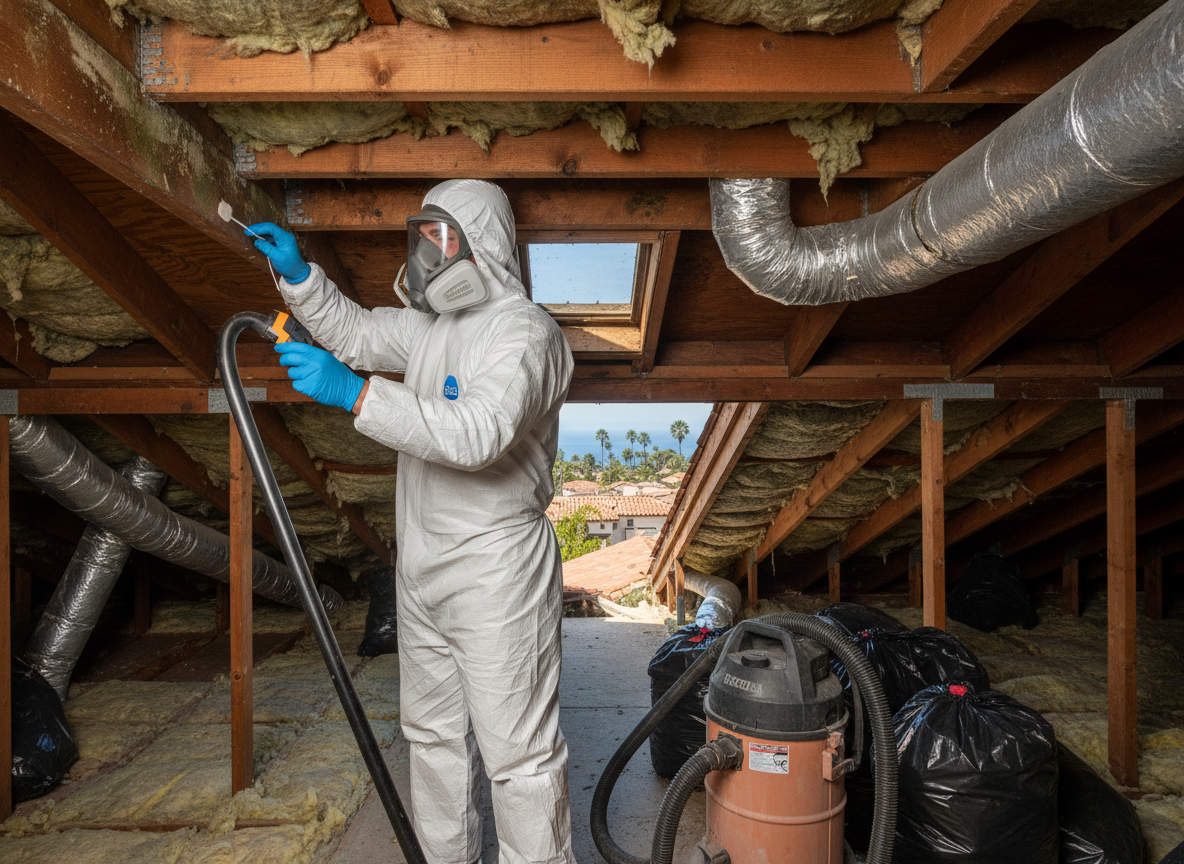
Corona Del Mar homes built before the 1980s often feature older roof assemblies and limited attic ventilation that trap condensation during the cool wet winters typical of the mild Mediterranean climate. Attics in Corona del Mar Village and Corona Highlands frequently develop mold on rafters or insulation after roof leaks or poor airflow allow moisture to linger into the dry summer months. Testing requires air and surface sampling plus moisture meters because visible growth rarely tells the full story behind insulation batts or in knee-wall cavities.
Removal work here must account for the steep bluff terrain near the Corona del Mar Bluff Path and Sherman Library and Gardens where salt air accelerates corrosion on metal flashing and increases leak risk. Technicians remove affected insulation, treat wood members with EPA-registered antimicrobials, and improve ventilation without disturbing original roof tiles common in Irvine Terrace. Homeowners in adjacent Newport Beach and Laguna Beach face similar conditions but encounter stricter coastal permitting that can extend project timelines.
Edge cases include mold migrating into HVAC returns located in attics and hidden growth under spray-foam insulation installed during recent renovations. Proper containment and negative air pressure prevent spores from reaching living spaces below, especially important in two-story homes where the attic floor doubles as a ceiling. Post-remediation verification includes third-party lab results to confirm clearance before any new insulation is installed.
Technician insight
In Corona Del Mar, the thing that catches most people out with Attic mold testing and removal is how the cool wet winters push moisture under the older clay tile roofs common in Corona Highlands, letting mold grow on the back side of insulation where standard visual checks miss it until the next dry summer brings musty odors downstairs.
Winter Leak in Corona del Mar Village Attic
After heavy winter rains a homeowner noticed a musty smell near the upstairs hallway. Inspection revealed water tracking along rafters from a small flashing failure above the garage. We contained the space, removed wet insulation, treated the wood, and added ridge venting before clearance testing allowed new insulation to be installed.
How it works
- 1
Initial Inspection
Technician arrives within hours, performs visual assessment and moisture readings throughout the attic space.
- 2
Testing and Containment
Air and surface samples are collected while plastic sheeting and negative air machines isolate the work zone.
- 3
Removal and Treatment
Affected materials are removed, surfaces are cleaned and treated, and ventilation upgrades are installed where needed.
- 4
Verification and Clearance
Independent lab testing confirms mold levels meet safe standards before re-insulation or homeowner re-entry.
Pricing
Pricing varies by attic size, extent of hidden growth, and whether insulation replacement is required; 24/7 dispatch from our Corona Del Mar location keeps response costs lower than emergency after-hours calls from out of town.