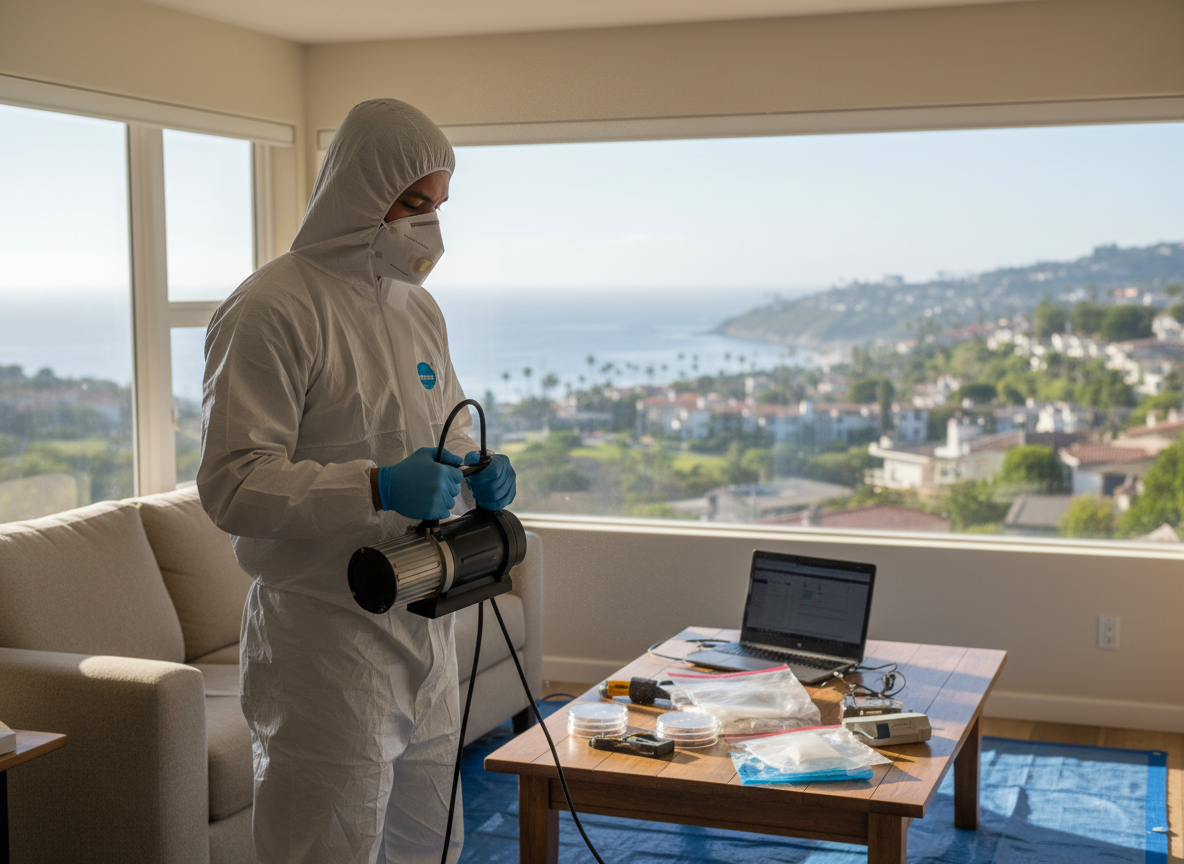
Mold spore testing in Corona Del Mar requires careful air and surface sampling because the mild Mediterranean climate brings cool wet winters that drive moisture into older stucco and wood-frame homes in Corona del Mar Village and Irvine Terrace. These seasonal rains often push humidity through rooflines and window seals on bluff properties near the Corona del Mar Bluff Path, creating hidden growth that standard visual checks miss. Technicians collect samples from multiple interior zones and compare them against outdoor baselines drawn from nearby Corona del Mar State Beach air to isolate whether indoor levels indicate an active issue.
Homes in Corona Highlands and along Pacific Coast Highway frequently feature crawl spaces and attached garages that trap moisture from summer fog and winter storms rolling in from Newport Beach and Laguna Beach. Spore testing protocols here include targeted wall cavity and HVAC register sampling because spores travel through ductwork and settle in finished basements or bonus rooms. Results guide whether remediation is limited to a single bathroom or extends to adjacent living areas where cross-contamination has occurred.
Local building stock from the 1960s onward often lacks modern vapor barriers, so testing must account for how soil moisture from the coastal bluff migrates upward. Reports detail spore types and concentrations room by room so homeowners can prioritize repairs before drywall removal or containment begins. This data also helps distinguish between normal outdoor infiltration common near Sherman Library and Gardens and true interior amplification.
Technician insight
In Corona Del Mar, the thing that catches most people out with mold spore testing is how our cool wet winters push moisture up through older slab foundations in Corona del Mar Village homes. Homeowners often test only the obvious bathroom and miss spores that have traveled through the HVAC into upstairs bedrooms after a heavy January rain.
Hidden Spores in Bluff Home
A Corona Del Mar homeowner noticed musty odors after winter rains but saw no visible mold. Testing revealed elevated aspergillus spores in second-floor bedrooms connected to the crawl space. Samples from the garage and HVAC confirmed the source. Containment and targeted drying were completed before any drywall was opened.
How it works
- 1
Initial Consultation
Discuss visible moisture history and recent weather impacts on the Corona Del Mar property.
- 2
On-Site Sampling
Collect air and surface samples from affected rooms plus outdoor control locations near the beach.
- 3
Laboratory Analysis
Send samples for spore identification and concentration measurement with comparison to regional norms.
- 4
Detailed Report Delivery
Provide findings with room-specific recommendations for next steps in remediation.
Pricing
Cost depends on square footage, number of samples required, and whether wall cavity testing is needed.