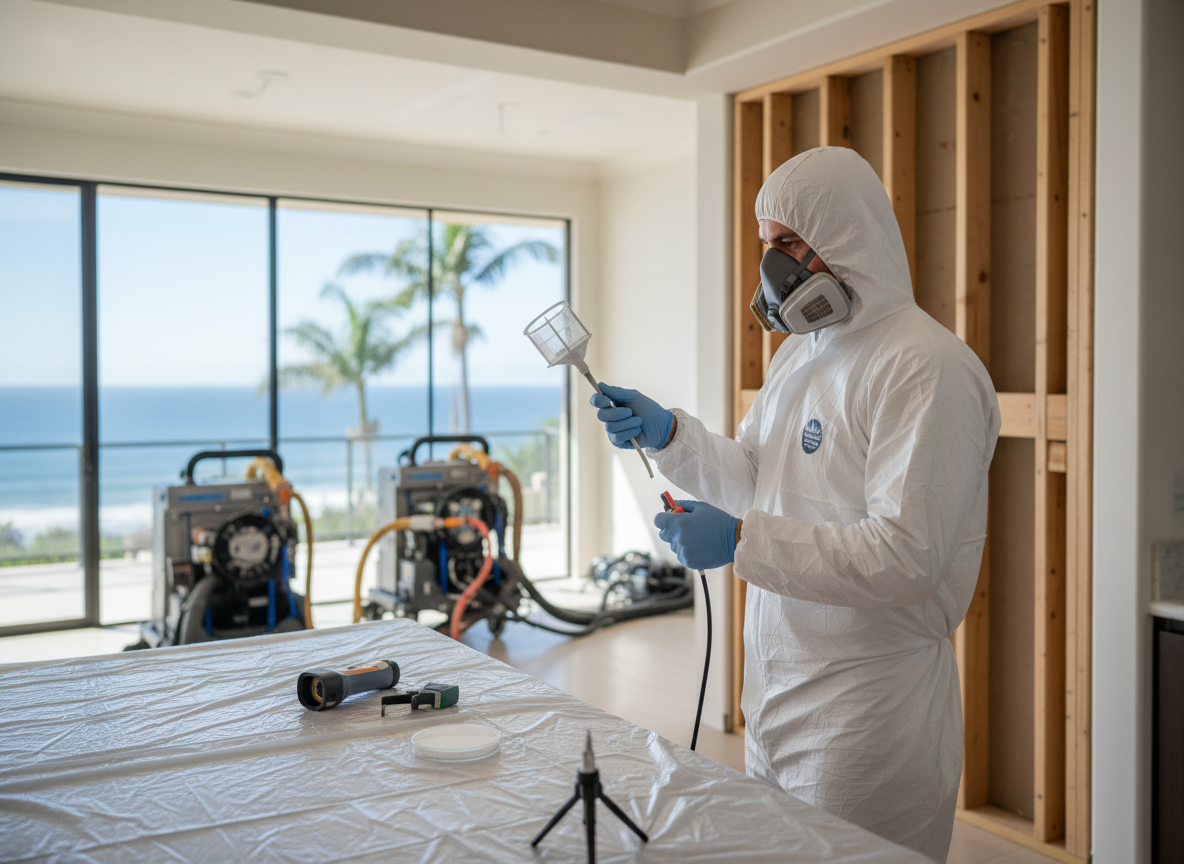
Post remediation mold testing in Corona Del Mar focuses on air and surface sampling after initial mold removal to confirm no active growth remains. Homes in Corona del Mar Village and Corona Highlands often date to the mid-20th century with original plaster and wood framing that can trap residual spores near the bluff. Technicians collect samples from HVAC returns, wall cavities, and attic spaces where ocean humidity from the nearby Corona del Mar State Beach can reintroduce moisture during the cool winter months. Clearance requires spore counts to match or fall below outdoor baselines taken at Sherman Library and Gardens.
The mild Mediterranean climate brings concentrated winter rains that test the effectiveness of drying equipment used during remediation. In Irvine Terrace properties built on sloped terrain, water can migrate along foundations from Laguna Beach and Newport Beach storm runoff, creating edge cases where visible mold is gone but elevated moisture persists behind baseboards. Testing protocols include moisture meter readings at multiple depths and ERMI dust analysis when previous remediation involved porous materials like carpet padding or drywall in bathrooms.
Regulatory expectations in Orange County emphasize third-party verification rather than self-certification by the remediation crew. This step protects against recontamination in sealed coastal homes where warm dry summers mask slow leaks until the next wet season arrives. Reports detail chain-of-custody for samples sent to accredited labs and note any areas that may need targeted follow-up sealing around window frames facing the Bluff Path.
Seasonal Moisture Patterns
Cool wet winters in Corona Del Mar increase the risk of condensation inside wall cavities after remediation if dehumidification was not run long enough. Testing during these months often reveals hidden issues missed in summer inspections when outdoor humidity stays low.
Technician insight
In Corona Del Mar, the thing that catches most people out with post remediation mold testing is salt-laden air from the Pacific accelerating corrosion on metal HVAC components in homes built before 1970 in Corona Highlands. Homeowners often skip checking the return plenum after remediation, allowing spores to recirculate once the system restarts during the first warm spell after winter rains.
Hidden Moisture Behind Original Plaster
A homeowner in Corona del Mar Village called after remediation because musty odors returned near the master bath. Testing revealed elevated moisture in the original 1950s plaster wall shared with an exterior bluff exposure. Additional drying and targeted surface sampling confirmed clearance once the leak path from seasonal runoff was sealed.
How it works
- 1
Initial Site Walkthrough
Technician inspects all previously affected rooms in the Corona Del Mar home, noting any new staining or odors since remediation finished.
- 2
Sample Collection
Air and surface samples are taken from indoor zones and compared against an outdoor control sample collected near Corona del Mar State Beach.
- 3
Moisture Assessment
Readings are recorded at foundation walls, HVAC registers, and attic sheathing to detect residual dampness common after winter rains.
- 4
Lab Analysis and Report
Samples are processed and a written clearance report is delivered within 48 hours, including recommendations if counts exceed safe thresholds.
Pricing
Pricing depends on square footage tested and number of samples required; most Corona Del Mar homes need three to six samples for reliable clearance.